Defying Definition: Lance Peterson & the Pursuit of Excellence Beyond Wrestling
10/20/2026 3:11:00 PM | Wrestling
CHARLESTON, S.C. -- Lance Peterson doesn't believe in choosing just one path. A wrestler, a cadet, and a chemistry major at The Citadel, he's proving that success doesn't have to come in a single form.
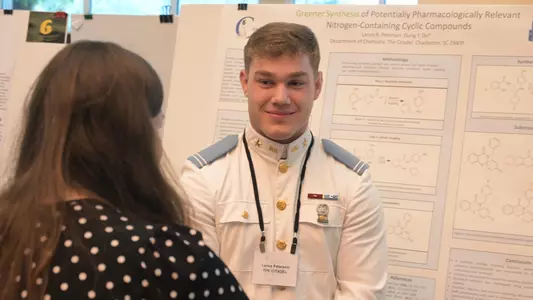
This year, that mindset led him to a podium finish at the Southern Conference Undergraduate Research Forum (SURF), where he placed second in the poster presentation competition. The recognition wasn't just a personal achievement, but rather served as validation for months of work on a project that could help change how critical medicines are made.
As he puts it, the forum was "an opportunity for every undergraduate researcher in STEM to go up to Wofford University to present the research that they conducted this past summer."
He entered without big expectations, but the result spoke for itself.
"It was a competition and I kind of just threw my hat in the ring, not expecting much, but ended up placing second."
For Peterson, the win was about more than a medal. It was a testament to the idea that you can thrive in every part of your life if you're willing to do the hard things, and that's exactly what he's built his Citadel experience around.

Finding a Greener Way Forward
The heart of Peterson's project was a challenge: could he and his professor create a more sustainable way to synthesize nitrogen-containing heterocycles -- compounds used in treatments for everything from Alzheimer's to diabetes -- without the harmful byproducts and costly processes typical of current methods?
He explained that these compounds "are found in a lot of pharmacologically relevant compounds," but the traditional way to make them "requires transition metal catalysts, elevated temperatures, hazardous reagents and a long synthetic process."
Together, he and his professor paved a new path for production.
"We came up with an alternative reagent and an alternative synthetic approach to produce these exact same compounds that is cost effective and environmentally friendly."
Their breakthrough was rooted in simplicity.
"We had a synthesis -- it's called one pot synthesis -- where we take all of our reagents and starting materials, we put them in one pot and then we get a product."
By removing the transition metal catalyst and streamlining the process, they created a cleaner, more efficient approach that could be hard to ignore.
"Once we prove that the product is the exact same and it's cost effective and it's easier to produce, it's going to be undeniable to go back to the old ways."
For Peterson, the project has also helped shape his future. He sees research as a long-term calling.
"Some of these compounds have been found to be relevant in type one diabetes treatment. I think this would be a great backbone to my future research, it's a great end goal for when I'm older."

Balancing the Mat and the Lab
Peterson's days aren't easy. They aren't meant to be. Between wrestling, the Corps, and his coursework, he's learned to thrive in high-pressure environments.
"I like doing hard things. I mean, that's why I came to this school. I definitely could have taken the easy road, but I wanted to take the road less traveled."
That mindset shaped his summer routine: "I would be in the lab from 8 a.m. to 4 p.m. and then be practicing right afterwards. I'd go to practice and have the goggle marks on my eyes. My hands would smell like the gloves I was wearing and then Coach McCall would be like, 'I can tell you were just in the lab all day.'"
He didn't mind. In fact, he was exactly where he wanted to be, pushing himself in every area of his life.
He also found a surprising link between wrestling and research.
"Wrestling has actually helped my research, just the unrelenting nature of never giving up. A lot of guys will be in the lab and then one thing doesn't work one time and they give up, but I can't do that on the wrestling mat. I can't be like, 'my high crotch isn't working. I'm just going to never shoot a high crotch ever again.' It's the same with research."
That persistence paid off when his professor tasked him with creating a compound that had previously been out of reach.
Peterson succeeded, and it sparked a new line of inquiry for the lab.
"He said, 'wow, this proves that we can do this,' and that inspired a new project for him. That's probably going to be a few years from now and another undergraduate researcher will take my place, but that's the end goal, right? Inspire the next generation of students to come in and complete that research."
Changing the Narrative
Peterson knows the stereotypes that come with being an athlete, especially when it comes to academics. He's intent on breaking them.
"I don't want to be just defined by one thing. I don't want to just be a wrestler or just be a cadet or just be a chemistry major. I want to thrive in everything I do."
His work at the forum helped prove that point. To make his complex project accessible, he added a creative touch to his presentation.
"I also had a QR code that linked to a time lapse of my research, that way you can physically see what I'm doing instead of me just describing it to you."
He's also found a way to give back on campus.
"I'm actually an organic chemistry tutor, the only one on campus, in fact."
It's another way he's using his talents to serve others and help lift those around him.
Looking ahead, Peterson remains focused on publication and continuing the momentum his team has built.
"We're hoping to get published by the end of next year. We're currently in the draft phase of our research."
Wherever he goes next, whether it's a new research project, another wrestling season, or a future career in medicine, Peterson will keep doing what he does best: taking the hard road, and proving that it leads to remarkable places.

This year, that mindset led him to a podium finish at the Southern Conference Undergraduate Research Forum (SURF), where he placed second in the poster presentation competition. The recognition wasn't just a personal achievement, but rather served as validation for months of work on a project that could help change how critical medicines are made.
As he puts it, the forum was "an opportunity for every undergraduate researcher in STEM to go up to Wofford University to present the research that they conducted this past summer."
He entered without big expectations, but the result spoke for itself.
"It was a competition and I kind of just threw my hat in the ring, not expecting much, but ended up placing second."
For Peterson, the win was about more than a medal. It was a testament to the idea that you can thrive in every part of your life if you're willing to do the hard things, and that's exactly what he's built his Citadel experience around.
Finding a Greener Way Forward
The heart of Peterson's project was a challenge: could he and his professor create a more sustainable way to synthesize nitrogen-containing heterocycles -- compounds used in treatments for everything from Alzheimer's to diabetes -- without the harmful byproducts and costly processes typical of current methods?
He explained that these compounds "are found in a lot of pharmacologically relevant compounds," but the traditional way to make them "requires transition metal catalysts, elevated temperatures, hazardous reagents and a long synthetic process."
Together, he and his professor paved a new path for production.
"We came up with an alternative reagent and an alternative synthetic approach to produce these exact same compounds that is cost effective and environmentally friendly."
Their breakthrough was rooted in simplicity.
"We had a synthesis -- it's called one pot synthesis -- where we take all of our reagents and starting materials, we put them in one pot and then we get a product."
By removing the transition metal catalyst and streamlining the process, they created a cleaner, more efficient approach that could be hard to ignore.
"Once we prove that the product is the exact same and it's cost effective and it's easier to produce, it's going to be undeniable to go back to the old ways."
For Peterson, the project has also helped shape his future. He sees research as a long-term calling.
"Some of these compounds have been found to be relevant in type one diabetes treatment. I think this would be a great backbone to my future research, it's a great end goal for when I'm older."
Balancing the Mat and the Lab
Peterson's days aren't easy. They aren't meant to be. Between wrestling, the Corps, and his coursework, he's learned to thrive in high-pressure environments.
"I like doing hard things. I mean, that's why I came to this school. I definitely could have taken the easy road, but I wanted to take the road less traveled."
That mindset shaped his summer routine: "I would be in the lab from 8 a.m. to 4 p.m. and then be practicing right afterwards. I'd go to practice and have the goggle marks on my eyes. My hands would smell like the gloves I was wearing and then Coach McCall would be like, 'I can tell you were just in the lab all day.'"
He didn't mind. In fact, he was exactly where he wanted to be, pushing himself in every area of his life.
He also found a surprising link between wrestling and research.
"Wrestling has actually helped my research, just the unrelenting nature of never giving up. A lot of guys will be in the lab and then one thing doesn't work one time and they give up, but I can't do that on the wrestling mat. I can't be like, 'my high crotch isn't working. I'm just going to never shoot a high crotch ever again.' It's the same with research."
That persistence paid off when his professor tasked him with creating a compound that had previously been out of reach.
Peterson succeeded, and it sparked a new line of inquiry for the lab.
"He said, 'wow, this proves that we can do this,' and that inspired a new project for him. That's probably going to be a few years from now and another undergraduate researcher will take my place, but that's the end goal, right? Inspire the next generation of students to come in and complete that research."
Changing the Narrative
Peterson knows the stereotypes that come with being an athlete, especially when it comes to academics. He's intent on breaking them.
"I don't want to be just defined by one thing. I don't want to just be a wrestler or just be a cadet or just be a chemistry major. I want to thrive in everything I do."
His work at the forum helped prove that point. To make his complex project accessible, he added a creative touch to his presentation.
"I also had a QR code that linked to a time lapse of my research, that way you can physically see what I'm doing instead of me just describing it to you."
He's also found a way to give back on campus.
"I'm actually an organic chemistry tutor, the only one on campus, in fact."
It's another way he's using his talents to serve others and help lift those around him.
Looking ahead, Peterson remains focused on publication and continuing the momentum his team has built.
"We're hoping to get published by the end of next year. We're currently in the draft phase of our research."
Wherever he goes next, whether it's a new research project, another wrestling season, or a future career in medicine, Peterson will keep doing what he does best: taking the hard road, and proving that it leads to remarkable places.
-- #NextDogUp --


Players Mentioned

/ Wrestling
Monday, January 26
Monday, January 26
Monday, January 26
Friday, December 19