Jody Huddleston Reflects on 40-Year Coaching Career at The Citadel
6/30/2026 11:30:00 AM | General, Men's Cross Country, Women's Cross Country, Track & Field
Share:
By: Matthew Shimko | The Citadel Athletics
Share:
CHARLESTON, S.C. -- When Jody Huddleston was asked to summarize a coaching career that spanned nearly five decades, including 40 years at The Citadel, one word came to mind: "Wow."
Huddleston arrived in Charleston in the spring of 1986 expecting another step in a young coaching career. He could not have known that The Citadel would become his home, Charleston would become his community or generations of cadet-athletes would pass through a program built around his standards.
"I had no idea that I would be here this long," Huddleston said. "For the longest time, I didn't know what I would do if I wasn't coaching, but now I'm in a place where I'm at peace and ready to step away."
Huddleston will officially retire as The Citadel's Director of Cross Country and Track & Field on June 30, concluding one of the longest and most influential coaching tenures in school history. During his four decades at The Citadel, Huddleston presided over more than 100 individual Southern Conference titles, 450-plus All-SoCon performances and numerous NCAA regional qualifiers. He coached Olympic Trials competitors, conference record-holders, school record-holders and some of the pioneering women who changed the history of athletics at The Citadel.
The numbers tell part of the story. The athletes, relationships and standards tell the rest.
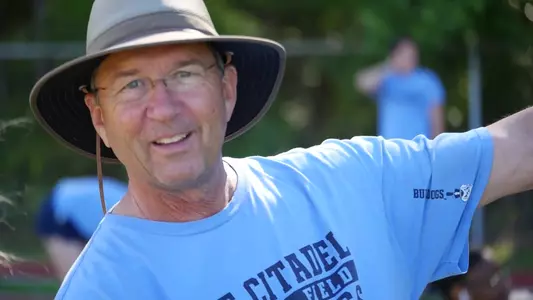
Whether on the track or in the throwing area, Huddleston's passion for coaching was evident throughout his 40 years at The Citadel.
The Road to Charleston
Huddleston began coaching almost immediately after completing graduate school at South Alabama. At 24 years old, he accepted the head coaching position at Oklahoma Baptist University, where he spent seven seasons and earned NAIA District IX Coach of the Year honors in 1984. His path from Oklahoma to The Citadel began through a professional relationship that grew out of a shared connection to Oklahoma Baptist.
Gary Wilson, an Oklahoma Baptist graduate and former NAIA national champion, had established a scholarship at OBU, and Huddleston made it a point to keep him regularly updated on the student-athletes who received it. Years later, Wilson was teaching at The Citadel as part of the Health and Exercise Science Department. When an opportunity opened for a track & field coach, he thought of Huddleston and picked up the phone: "He said, 'Would you be interested in a Division I job?'" Huddleston recalled. "I said, 'Well, sure.'"
Huddleston traveled to Charleston, interviewed and accepted the position. He was in his early 30s and entering an environment unlike anything he had previously experienced. The Citadel's terminology and traditions took time to understand.
"I had no idea," Huddleston said. "I didn't know any of the terminology. I was totally out of my element."
Huddleston credited graduate assistant and former Citadel hurdler Steve Medill with helping him understand the institution. Medill explained the language, structure and expectations that shaped daily life on campus. Huddleston learned that the cafeteria was the mess hall, the dorms were the barracks and the acronyms and customs that came as second nature to cadets were completely foreign to their new coach. Huddleston joked that he and the freshmen who arrived that fall were all knobs together.
The adjustment took time, but the environment eventually became one of the reasons he stayed. Huddleston had attended and coached at smaller institutions, and he appreciated the tight-knit connections that came with a smaller campus. The Citadel provided that environment, while Charleston offered a scenic and welcoming community in which to raise a family. He had opportunities to pursue larger programs and potentially larger salaries, but he never found a reason strong enough to leave.
"The atmosphere, I loved being at a small school," Huddleston said. "You don't get lost in all the numbers."
Changing the Standard
Huddleston's earliest challenge was not producing conference champions. It was changing the program's culture. About a year after he arrived, a campus employee told him that the track and field program had previously developed a poor reputation. Athletes had struggled with discipline, damaged locker-room property, ignored uniform expectations and failed to meet institutional standards.
"It was like a dagger in my heart," Huddleston recalled.
Huddleston met individually with members of the team and outlined what the program would become. Some athletes decided not to continue, while those who remained began establishing a different identity alongside the freshmen Huddleston inherited and recruited. Academics became one of the program's primary priorities.
Huddleston wanted his athletes to compete successfully, but he also expected them to attend class, complete their work and understand that their responsibilities extended beyond practices and meets. Those expectations included punctuality, preparation and accountability.
"Ten minutes early is on time," Huddleston said.
Athletes learned quickly that meeting the standard meant taking full responsibility for their time and role within the group. Huddleston viewed those lessons as preparation for life after graduation. His goal was not simply to produce faster runners, stronger throwers or more polished jumpers, but rather to help develop dependable adults who understood accountability, discipline and the value of doing difficult things without complaining.
"I am so proud of our academic success over all these years," Huddleston said in announcing his retirement. "Throughout my time here, these men and women did what was necessary to compete at the highest level. They worked hard, never complained and still became SoCon champions and All-Conference performers."
A Program & Institution Evolved
The Citadel underwent significant changes during Huddleston's tenure, including the addition of new buildings, renovated facilities and changes to practice spaces. None was more important than the institution's transition to coeducation. Huddleston called the addition of women the largest change he witnessed during his 40 years on campus and one of the most positive developments in the institution's history.
"Everything evolves," Huddleston said. "You either evolve or get left behind."
Mandy Garcia became the first woman to compete in intercollegiate athletics at The Citadel when she joined the cross country and track & field programs in 1997. Track & field and cross country were uniquely positioned to provide the first opportunity, as a complete soccer or volleyball team could not be built around one athlete, but Garcia could enter a race and compete individually almost immediately. A year later, Huddleston had recruited enough women to field a full cross country team.
"When The Citadel became coeducational, Coach Walt Nadzak called on Jody to lead the department down a path the institution had not yet traveled," Director of Athletics Art Chase said. "Jody responded just like we all knew he would. At that particular moment, The Citadel needed Jody, and The Citadel needed Mandy. While there were challenges, everyone was better for having lived through that experience because of how Jody and Mandy handled themselves.
"Maybe the best part is that Jody will give the credit to Mandy, and Mandy will give the credit to Jody. In reality, it was the combination of the two that set Citadel Athletics up for future success."
Mandy Garcia became the first woman to compete in intercollegiate athletics at The Citadel in 1997.
The program's early women continued breaking barriers. Toshika "Peaches" Hudson-Cannon was one of several athletes who made a lasting impact during Huddleston's tenure. In 1999, she stood as the first female from The Citadel to secure All-Southern Conference honors in school history via a second-place finish in the heptathlon. Three years later, Hudson-Cannon was one of seven women who became the first African-American female cadets to graduate from the Corps of Cadets. She continues to mentor current cadets and support the next generation of cadet-athletes.
Dr. Stephanie McNeill also achieved historic success during Huddleston's tenure. A four-time Southern Conference champion and seven-time All-SoCon performer, she became the first female cadet-athlete to win a conference title and the first woman to represent The Citadel in NCAA postseason competition. McNeill was named the SoCon Female Field Athlete of the Year in 2006 and 2007 before becoming the first woman inducted into The Citadel Athletics Hall of Fame. She later earned her medical degree and is now a board-certified neurologist specializing in vascular neurology.
Stephanie McNeill became the first female cadet-athlete to win a Southern Conference championship and compete in NCAA postseason competition.
For Huddleston, their impact extended far beyond competition, as athletes like McNeill exemplified the program's broader mission.
"Many of our former athletes have gone on to become doctors, military officers, educators, business leaders and other professionals, and their success after graduation reflects the values instilled during their time at The Citadel," he said. "That's what I'm most proud of. That's the whole point."
Champions Through Commitment
The Citadel's track & field program did not always have the facilities enjoyed by fellow conference members. When Huddleston arrived, the Bulldogs trained on an asphalt track. At other points, athletes practiced on grass at Hampton Park, ran stadium steps or traveled to Mount Pleasant to use the track at Park West, adding nearly an hour of travel to each practice day.
Huddleston did not ignore those limitations, but he refused to allow them to become excuses.
"The thing that was impressive about these kids is that they bought into it," Huddleston said. "They worked hard no matter what, no matter what we had. We were still producing conference champions and All-Conference performers, and we were running on dirt and grass."
One of the program's most notable achievements under Huddleston came at the Penn Relays, where the Bulldogs captured five consecutive military 4x100-meter relay titles. The streak culminated in 2007, when Wesley Merriweather, Quintin Wright, Thomas Pressley and Andre Roberts combined for 42.35 mark and hold off Army to secure another championship at one of the world's oldest and most prestigious track & field meets.
Capers Williamson remains The Citadel's school record-holder in the javelin with a throw of 72.95 meters. He also captured Southern Conference championships in the event in 2015 and 2016 before becoming the first Citadel cadet-athlete to advance to the final round of the U.S. Olympic Trials. Williamson placed eighth in the javelin in 2016, bringing the Bulldogs onto the national stage.
Capers Williamson remains The Citadel's school record-holder in the javelin and won Southern Conference championships in 2015 and 2016.
Williamson became the first Citadel athlete to advance to the final round of the U.S. Olympic Trials, placing eighth in the javelin in 2016.
Just a few years later, Huddleston coached another standout group whose careers overlapped during a historic 2018 season. Malik Diggs captured conference titles in the 60-meter hurdles, 110-meter hurdles and 400-meter hurdles during his tenure with The Citadel. Mady Riegel won consecutive SoCon javelin championships, set the school record and became the first Bulldog to advance to the finals of an event at the Penn Relays. Josiah Johnson developed into one of the program's top sprinters, winning conference titles in the 100 meters and 4x100-meter relay.
A four-time Southern Conference outdoor champion, Malik Diggs swept the 110-meter hurdles and 400-meter hurdles titles in 2017 and 2018.
Josiah Johnson helped lead The Citadel's historic 2018 team, capturing Southern Conference championships in the 100 meters and 4x100-meter relay.
Mady Riegel captured back-to-back Southern Conference javelin titles in 2016 and 2017.
The Bulldogs finished the 2018 season with nine conference champions, 24 All-SoCon performers, more than 20 school records and a new Southern Conference record. Diggs and Johnson also advanced to the preliminary rounds of the NCAA Championships while Riegel earned her third All-SoCon recognition with a second-place finish in the javelin.
Huddleston emphasized that those athletes represented only a small portion of the people who shaped the program, noting that he could spend hours sharing stories about those he coached throughout his career. He remembered the championships and records, but he also remembered the dropped batons, missed opportunities and difficult moments.
"You look back and cherish all the victories," he said, "but you also remember some of the valleys, and those are part of the journey. Looking back, I'm grateful for all of it, the good and the bad."
A Lesson in Resilience
One of Huddleston's favorite examples of the program's identity centered on Dr. Jamel Brown, a former Bulldog hurdler who earned two Southern Conference championships, 13 All-SoCon honors and two NCAA postseason appearances from 2006-09. Brown later became a physician and was inducted into The Citadel Athletic Hall of Fame in 2024.
Dr. Jamel Brown competes in the 110-meter hurdles during his decorated career as a Bulldog
Brown entered the Southern Conference Championships as one of the favorites in both hurdles events. After winning the 110-meter hurdles, he later lined up for the final of the 400-meter hurdles.
Brown was leading when he struck the second hurdle and fell, allowing the rest of the field to pass him. Rather than remain on the track, he rolled through the fall, returned to his feet and continued running. Brown climbed from eighth place back to fourth and narrowly missed the podium.
Brown did not win, but Huddleston found greater meaning in his response.
"His tenacity, his getting up and finishing that strong, I would go to my team and say, 'That's exactly what we're trying to do here,'" Huddleston said.
Brown later married his teammate, Lathcha Sanders Brown, and together they built successful lives and careers in medicine. Sanders Brown was also a standout for the Bulldogs, winning the 2007 Southern Conference heptathlon championship, earning six All-SoCon honors and beating her husband into The Citadel Athletic Hall of Fame with her induction in 2022.
The story captured everything Huddleston sought to instill in his program: the character to get back up, continue forward and respond when life becomes difficult or does not go as planned.
The Reward of Teaching
When asked what he will miss and what he will not, Huddleston joked that he will not miss the long bus trips. After spending an entire day standing in the heat at a meet, finding a comfortable position on the ride home was nearly impossible. What he will miss most is the teaching.
For Huddleston, few moments were more rewarding than watching a cadet-athlete work through a new skill, struggle with it, repeat it and eventually understand exactly what needed to be done. It could be a hurdler finding the correct rhythm, a thrower mastering a new movement or a young athlete realizing that he or she belonged at the collegiate level.
"When it just clicks, they're a totally different person," Huddleston said. "They go from being meek and mild-mannered and struggling to having that confidence. They become team leaders."
Huddleston enjoyed seeing the moment when instruction became execution and an athlete could feel the difference for the first time. Those breakthroughs often changed more than a performance. They changed how athletes carried themselves, approached practice and supported their teammates. The medals, records and personal bests provided visible signs of progress, but what mattered most to Huddleston was watching athletes gain confidence through the learning process and carry that growth with them beyond their time at The Citadel.
Head football coach Maurice Drayton experienced Huddleston's influence as a student, an athlete and later as a colleague.
"Coach Jody Huddleston's impact reaches far beyond the track," Drayton said. "He has shaped generations of young men and women into better people through his leadership, mentorship and example. I was fortunate to know him as a student, an athlete and a colleague, and I'm grateful for the influence he has had on my life. Congratulations on an incredible career and a lasting legacy."
A Lasting Influence
Huddleston hopes to be remembered for the lessons he consistently tried to instill in his athletes: be responsible, be on time, work hard, prioritize academics, avoid excuses and always get back up after falling.
"Jody's legacy extends far beyond the championships, records and honors achieved during his career," Chase said. "His greatest impact can be seen in the generations of cadet-athletes he mentored and prepared for success beyond competition. His steady leadership, commitment to doing things the right way and genuine care for others have left a lasting mark on our department and this institution. We wish Jody and Mary Ellen the very best as they begin their next chapter."
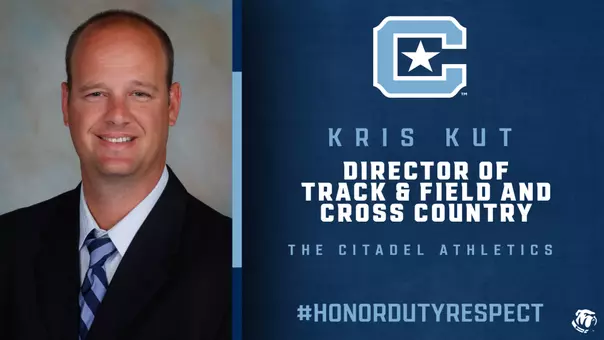
Longtime assistant Kris Kut experienced that influence firsthand while working alongside Huddleston for more than two decades. Together, they helped develop conference champions, All-SoCon performers and school record-holders while building relationships with generations of athletes.
"It's hard to put into words what Coach Huddleston means to me, our program and our school as a whole," Kut said. "He built something truly special and established a standard of excellence that will continue to guide us for years to come. His legacy will carry forward, and I hope to do everything I can to uphold what he worked so hard to build.
"Coach Huddleston was more than just a coach. He was a mentor, a friend and like a second father to me. It was an incredible ride, and I'm grateful for every lesson he taught me. He showed me how to lead, how to serve others and, most importantly, how to do things the right way. Thank you, Coach, for everything. Your impact on my life and on so many others will never be forgotten."
Throughout his final year, Huddleston's impact was celebrated across The Citadel community. In addition to a retirement celebration attended by former student-athletes, coaches, colleagues, family and friends, he was also recognized during pregame festivities ahead of The Citadel-South Carolina baseball clash, where he was honored on the field and threw out the ceremonial first pitch in recognition of his four decades of service to the institution.
Quick shoutout to our very own Jody Huddleston, who tossed out the ceremonial first pitch this past week against South Carolina!
— The Citadel Track & Field / Cross Country (@CitadelTFXC) March 19, 2026
Watch the tribute video, featuring messages from former student-athletes, coaches, colleagues and friends, that was played during Huddleston's retirement celebration below.
Huddleston never expected to spend 40 years at The Citadel, but looking back, he would not change a single part of his journey. Along the way, he and his wife, Mary Ellen, built a life in Charleston, raised their daughter, Mary Kathryn, and found a community they were proud to call home. Now, with the program in trusted hands, Huddleston looks forward to spending more time with Mary Ellen, Mary Kathryn, the rest of their family and their dog, Rosie, while enjoying the next chapter of a life rooted in family, faith and the city that became home.
"I don't regret one minute of it," Huddleston said. "I would do it all again."
Retirement will give Huddleston more opportunities to spend time with his family, including plenty of moments with his dog, Rosie.